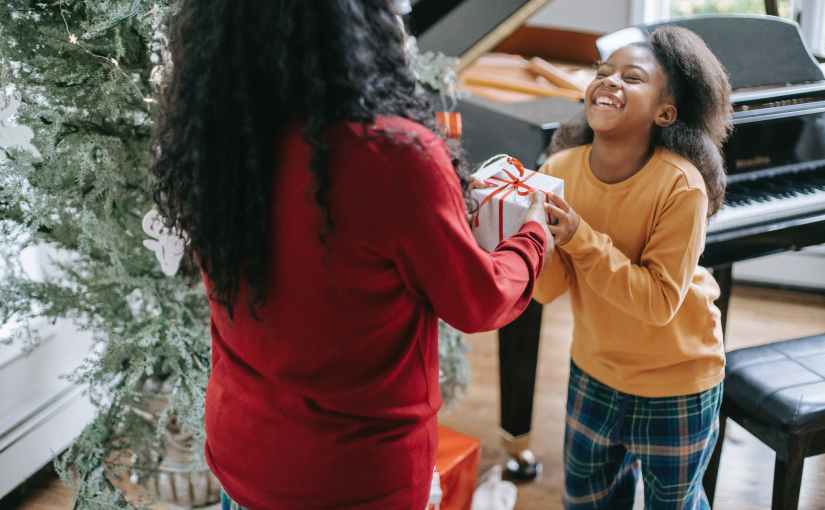
Opening Gifts –  Our Enthusiasm Almost Created a Monster

When kids are infants, they don’t understand what it means to receive a gift, let alone open one. It’s when they’re about three years old that they start to get the magic of Santa and the joy of opening presents. As parents, we were eager to watch our son, our first born, experience this. So eager we almost created a monster.  

Christmas Eve, after Payton went to bed, we stuffed his stocking and put out his Santa gift. I don’t remember what we got him. My memory was more around how eager I was to see his reaction the next morning.  Chad and I got up early so we wouldn’t miss it. 

When he came out of his room Christmas morning, Payton didn’t notice. He’d seen the gifts under the tree and the added gift wasn’t registering. So we urged him over to the tree and showed him his gift. When he realized it was his, he was thrilled to focus his attention on his new toy. But he still had a stocking, so we urged him to put his new gift aside and explore what was inside the giant sock. Candy, trinkets, and Legos. Payton was happy to open his Legos and start building. But we still had the gifts under the tree to open, so we urged him to put his Legos aside and said, “Hey Payton, put that down. Look at this one!”

Suddenly Chad and I stopped. We looked at each other, realizing what was happening. We were pushing our son to dismiss every gift he got so he could see what was next. 

Could we really be surprised next year if he presumptuously asked for his next gift? Nope. It would be our fault for teaching him to do exactly that. 

That’s not the kid we wanted to raise.

We paused. We let him build his Lego set. Chad opened a Lego set too, and they built them side-by-side. We’ve continued this tradition ever since. Everyone gets a small Lego set in their stocking and we pause while everyone puts theirs together. And we give fewer gifts. Everyone gets a gift from Santa and one gift from Mom and Dad. Just one. As our family grew (we have four kids) they got each other one gift, too. So there are a lot of presents to share. But we take our time, and we let everyone spend a few moments enjoying what they got before moving on. 

The art of saying “yes” is especially helpful during the holidays

During the holidays, treats are everywhere. Baking is a big part of how we celebrate so, at any given time, we have lots of different cookies or treats around the house. Stores have special holiday treats too, and, because it’s the holidays, we want to say “Yes” to everything. “Sure, you can have the candy cane the store clerk is handing out.” “Yes, I’ll get you a gingerbread cookie from the coffee shop (and yes please to my peppermint mocha).”

When we get home, the kids ask for a piece of fudge. Hmmm, I think to myself. They’ve just had treats. But the pieces of fudge are really small, and they were really good today, and it’s the holidays…..oh, why not. “Okay,“ I declare, “but eat these three carrot sticks first, then you can have one. But just one.” Those three carrot sticks make me feel better. 

After dinner, the kids want dessert. They usually have dessert, so one cookie would be normal. But they’re quick to point out we have so many tasty treats, how could they pick just one? Okay, you can have two. 

When I look back at the day, I realize I’ve given them more treats in one day than they usually have in a week. I didn’t mean for it to happen. We can’t keep going at this rate. At some point I have to say “no.” But when?

Chad and I talked about it. We wanted to let the kids have treats but not too many. We also wanted to minimize the time we spent managing them and limit arguments. So we decided on a compromise. We’d let the kids have two treats a day, everyday. Their choice. The only time we’d say “no” was if they’d already had their two treats for that day. Otherwise, the choices were theirs. The time of day didn’t matter. Want a piece of fudge for breakfast? Sure. The type of treat didn’t matter. Payton tended to pick from the two biggest options – large sugar cookies covered in thick frosting. 

The kids were thrilled with our new rules. “You mean I can have a cookie for breakfast?!” Umm, that wasn’t the point, but, yes, you can. 

On the first day they finished their two treats before noon. The rest of the day was tough as the kids tested the boundaries. 

“Pleeeaaassse?!!!” they cried after dinner when we told them they couldn’t have dessert because they’d already eaten their two treats for that day. Reality was setting in. 

“You’ve made your choices today, and I hope you enjoyed them.”

“But Mom, it’s just one small piece of peppermint bark!”

“You can have a piece tomorrow, if you want to.”

“But tomorrow is so far away! I haven’t had a treat since lunchtime.”

“True. You finished your treats early today. That means you had longer to wait. That must be hard. Tomorrow you’ll get to make a whole new set of choices. Maybe you can save one of your treats for later in the day. I look forward to seeing what you decide to do.”

The first two days were the hardest. The kids tested us to see if we’d stick to the rules. The best outcomes happened when we didn’t waiver. We knew we’d succeeded when the conversation changed. 

“Mom, are you making shortbread today?” 

“Yeah, why?” 

“Because I want to save one of my treats so I can have some tonight.”

(Silent celebration ensued)

Two for the price of one. Our intent was to manage how many treats they ate, but we got a second win. We got to watch the kids learn about delayed gratification and see the choices they made.


Key to success: 

  • Make sure you and your partner are committed to whatever you declare 
  • Tell the kids the rules before you start
  • Stick to your commitment*
  • Hold the kids accountable and capable

*If you find you’re unable or unwilling to stick to your commitment, rethink it. It’s okay to make a change. Maybe two treats is too few. Four? Okay, as long as you’re clear with the kids and you’re ready to stick to the new declaration. Repeatedly giving in will reinforce that begging works, and the kids will use that. For us, that was a miserable outcome, so a few days of tough love was well worth the long-term gain.

Thank you Jane Nelson, for your book Positive Discipline. You taught us the words and gave us the confidence to hold firm in situations like these. 

Teach Kids the Joy of Giving

This is a post about holiday giving. I’m writing this one a bit early because many people are already shopping to get ahead of supply chain issues. 

Giving gifts is work. Thinking about what the other person might want, searching for a gift, finding something great, only to realize you can’t afford it. Restarting your search. Kids couldn’t possibly understand all of this, but we can teach them.

Years ago Chad and I decided that at Christmas, all of our kids would give each other, and us, gifts. They were young, so we would pay for the gifts, but they had to choose, wrap and give them. We couldn’t afford much, so the price point was low. We’d take our kids to our local shops – Curious Kidstuff, Bartell Drugs, Click, Capers – and they’d search for gifts to give. 

Some of the gifts they’ve given: a pair of socks, a very small Lego kit, a book, a candle. You might think it would be a bit sad to receive a pair of socks. But, whoever received the socks appreciated them because they’d asked for “something cozy”. They knew the giver couldn’t afford a blanket (our price point was way too low for that). So, the cozy socks were appreciated. It’s not about the size or amount or cost of the gift. It’s the thought that counts. 

And kids learn the genuine joy of giving. I remember a gift I got from Emily. She was about five years old, and she was so excited for me to open the gift she’d gotten me. She bounced in her seat with anticipation. When I opened it, I saw a large necklace full of zinc zirconium (bright, “diamonds”). I’d asked for a “chunky” necklace, and she’d delivered. Part of her enthusiasm was, she explained, because the necklace was in the jewelry case at Target. To her, getting something from the jewelry case was truly special. I think she was more excited to watch me open my gift than she was to open her own. I couldn’t help but be touched. That was years ago, and I still remember it. True holiday spirit.

We’ve found so much joy and value out of this approach, I hope others will do the same. Please don’t be deterred by the possible cost. You can give homemade gifts. If you’re not naturally creative, it might feel odd at first, but if everyone is doing it, the appreciation for the thought and effort will come.