College drop-off was great, but the second day wasn’t.

Last weekend we dropped our oldest daughter, Mary, off at college. She was in a new city, Chicago, with new people around her. She’d wanted to go somewhere on her own – where no one from her highschool would be. A fresh start. I remember doing the same when I went to school. I grew up in Oregon and chose a school in D.C., so I understood.

My brother and his family live in Chicago. We flew in on Wednesday evening. Drop off was on Friday. Staying with them was a bonus. It was also a distraction. The night before drop off we were more focused on catching up with them, enjoying dinner on the patio at Athena, a Greek restaurant. The knowledge that this was our last night with Mary pushed to the back of our minds.

The next morning was easy going. Drop off was at 1:30pm. I went for a run. Chad and Mary packed up her things. At about noon, we realized Mary hadn’t eaten breakfast. Despite her desire to get going, we refused to let drop-off be ruined by the hangries. So we found a vegetarian restaurant nearby and ordered lunch. 

From then on, it was all about logistics. How long would it take to get there, where would she check-in, would they offer large bins to help get things from the car to their room, where would she get a room key, do they use room keys? 

When we dropped our son, Payton, off at college two years earlier, we’d only been allowed to help him unload the car. We had 15-minutes to do it. Covid-19 was a concern, and they wanted to limit exposure. 

After we unloaded Mary’s things we stayed to help her unpack. She’s like Chad. She wanted to settle in before doing anything else. Everything needed a place. So we helped unpack her clothes, set up her desk, hang pictures on the wall and organize everything else under her bed. Her brother Payton had come with us. The four of us squeezed into her tiny (“efficient”) room and got it done (Oh, and by the way, they don’t use room keys. She just taps her school ID on a pad on her door, like a hotel room. When I asked about a key at the front desk, the guy gave me a funny look. Apparently things have changed since I was in school).

We’d planned on leaving her that night. A few of her soccer teammates had also arrived and she’d planned to hang out with them. But, after she finished unpacking, no one was around (Fall athletes were all moving in before the rest of the students, so when they weren’t around, the dorms were empty). She texted her teammates and learned they were each having dinner with their families. Mary looked at us. “Of course you can have dinner with us!” We were pleased to have her just a little longer and neither of us wanted to leave her in the empty dorm by herself.

My sister-in-law had arranged a picnic at Millenium Park. We sat on the grass, eating bread, cheese, and salads and drinking wine, listening to music and looking at the skyline. I felt excited for Mary. What a cool place to be. So much going on. She’d have a lot to explore and, when needed, some family around to make her feel at home. It felt really good.

After dinner, we drove Mary back to her dorm. She said she was looking forward to some time alone, snuggled in her bed watching Netflix. She didn’t feel lonely or sad. She was ready to go. As we drove away, we felt accomplished. Our mission was complete. It was the next morning when the sadness started to settle in.

It was the same way when we dropped our son, Payton, off at the University of Portland two years earlier. The day after we left him at school, I felt sad. A piece of me had been left behind. The Frampton Clan was breaking up. I felt a sense of loss. Tears fell quietly throughout the day. At first I hid them from Chad, ducking into another room as they’d start. Giving myself a few minutes to cry, then I’d dry my eyes and rejoin him as if nothing had happened. 

The morning after we left Mary was the same. Tears quietly fell. I hid myself again, not wanting to alarm my brother. 

This time I told Chad as soon as it started. “It’s happening again. I’m sad. I’m okay, but today I’m going to be sad.” 

“Me too,” he replied.

I took comfort in the familiarity of my feelings. I knew what this was. I knew the sadness would pass. And, perhaps most importantly, I knew The Frampton Clan was still together. 

Saturday we got to see Mary one more time. She’d encouraged us to come by the campus in the afternoon to meet her roommate, who’d be moving in about 3pm. Our good friends Rene and Mark live in Evanston and joined us. They would be another safe haven for Mary should she need anything while at school. At 5pm we walked with Mary to the soccer field, where she was going to kick around with her teammates. We got to meet her coach. Mary gave us hugs and said, “It’s time for me to go.” 

Yep, it was.

Why I Deleted Instagram

A month ago I followed my daughter’s lead and deleted my Instagram app from my phone. That led me to find out what connection really means to me and how I can do it better, without social media. 

Mary announced she’d deleted the app during MIdwinter break. She’d committed to it for a week because, according to her, “I spend too much time scrolling.” I’d never been one to spend a lot of time on Instagram, but I understood what she meant. 

I use Instagram because I want to stay connected. I like seeing what’s happening with my family. I see posts about my sister’s family visiting Central Oregon, nieces and nephews at college, and my cousin’s family in France (Ishe married a Frenchman, has two adorable French-American sons and posts beautiful pictures of their adventures). I like seeing what’s up with friends I don’t see very often. Friends who live on Bainbridge Island, friends in Oregon, and the East Coast. Even my dear friend who’s right here in West Seattle, but whom I still don’t see as often as I’d like. 

Despite my desire to stay connected, I decided to follow Mary’s lead, and I deleted Instagram. At this point it was less of a commitment. It felt good because it meant I wasn’t supporting Meta (aka Facebook). There have been news stories about former employees who say Meta ignores important data about the harmful effects their algorithms are having (e.g. emphasizing diets and extreme weight loss with girls) and lack of action against people and communities proliferating information known to be false (2020 election was stolen). So, deleting it felt good. But it would leave a gap. 

How would I stay connected to friends and family? I’m not very good at reaching out. Instagram had given me a way to quickly, on my terms, see what was going on in their lives. How would I fill the gap? 

The answer turned out to be really simple.

One night, I sat on my couch after dinner. A blanket draped over my legs and Freddy, our orange and white cat, curled up in my lap. I’d been thinking about one of my friends, wondering how she was doing. I think about my friends often, but normally I let the thoughts come and go. This time I picked up my phone and sent her a text. “Hey, thinking about you and wanted you to know it. Hope you’ve had a good day and week!” I thought of another friend. I texted her something similar, but not quite the same. I texted two other friends. Different words, but the same message – I’m thinking about you. 

Those four people are important to me, and it felt good to tell them so.

One friend responded right away. We went back and forth for a while, sharing updates about each of our lives. I learned a lot in those few minutes. Some of what she shared I probably could have learned on Instagram. But I also learned stuff that’s not posted anywhere. She told me it had been a tough day because she was struggling with a couple of things. She thanked me for reaching out. It had made her feel a bit better. 

Another friend responded. She asked, “You up for a call?” I hadn’t talked with her in almost two years. “Sure!” My phone rang. When I picked up and heard her voice a smile spread across my face. It had been too long. We diligently shared updates on each family member. She’s good about that – she makes sure to check in on everyone. And she remembers scary details. Like my kids’ birthdays. I couldn’t even guess at her boy’s birthdays. She talked about her husband. He’s in law enforcement and it’s been a tough two years (“defund the police”).  We hung up at about 10:30 pm. It was late for a weeknight, but my heart was full. I felt more connected to these friends in one evening than I had in years of following their Instagram posts. 

That night, I understood something I’d been trying to figure out. Why staying up to speed on social media doesn’t fill my cup. 

On social media, people only post the good stuff. Happy gatherings, dinners out with friends, traveling, funny anecdotes. Everyones’ smiling. It’s beautiful and fun to see. But what about the rest? Where are the stories about the days that don’t go so well? I don’t feel happy all the time. To feel connected to someone, I want to see all of their sides. I want to share all of my sides. 

The algorithms are a problem, too. One day I’d scroll through a few posts, like some of them, and the next time I checked in, the algorithm had adapted and focused all of my posts on the sites I’d liked last time. Friends and family who didn’t post very often were deprioritized. I’d spend time looking for them, scrolling and scrolling, passing the ads and the multiple posts by the same person. I was spending more time navigating than connecting. 

That night I learned that I can stay connected, and I can do it better without social media. 

I’m not using social media to connect to friends or family anymore. I’m going to use my good old fashioned phone. I’m going to reach out and say “hello” when the thought comes to me. Texting lets me do that without interrupting them. And, if they’re available, maybe we’ll make time for a live chat. 

Car Rides & Carpools

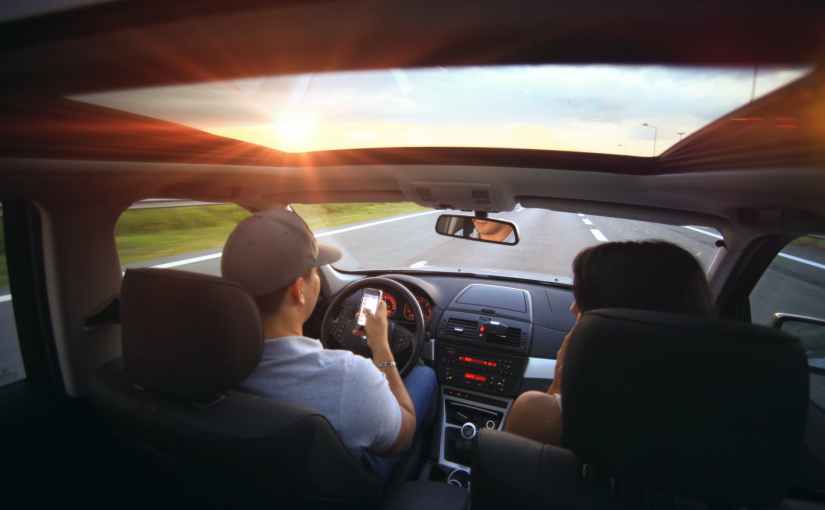
Want to know what your kids are thinking? Take them on a car ride or drive their carpool.

Yesterday I drove my son, Payton, back to college. He goes to the University of Portland, a 3-hour drive from Seattle. It was just me and him. Our family established an expectation that whoever is in the passenger seat has the job of keeping the driver awake and tending to their needs – unscrewing the top of my water bottle, getting my snack out of my backpack and putting it within reach, or sending a text. All of this to ensure a safe drive to wherever you’re going. So, Payton didn’t put on his headphones and zone out. He sat beside me and we chatted. On that drive I learned a lot, and it reminded me how valuable car rides with kids can be at finding out what’s on their minds.

I didn’t start the conversation. I left some silence and Payton filled in. He’s considering changing majors, and he shared what he learned from a conversation he had with a counselor. I asked some probing questions, like what was driving his desire to make a change. Physics was proving tough. Was Payton running from it? He reassured me he doesn’t love physics, but that’s not what’s driving his thinking. 

There would be lulls in the conversation. Then, because there wasn’t anything else to do, Payton would share more. 

I learned that he’d been concerned about his performance at school but was feeling better after his counselor made a few comments indicating Payton was doing just fine. Even better than others in some areas, like ‘statics’. I learned that, unlike a couple of his friends, Payton is not considering taking a semester off from school if they go virtual (Covid 19 cases are rising again with the omicron variant and there’s talk of schools going virtual). We reflected on a conversation we’d had with family during the holidays that covered several issues we don’t agree on – politics, women’s rights, vaccinations. Hearing Payton’s reactions to our family’s point of view was both funny and reassuring (side-note, I’m grateful to my family for having conversations like the one we did. It’s not easy these days, and we all agreed we need to keep talking). 

I asked Payton if he’d mind taking time for a sit down lunch. I was getting hungry and not much was available – we were well past Chehalis by this point. But a McMenamins was coming up in Kalama – a Pacific NW pub serving handcrafted beer and good pub fare. I didn’t need the beer, but I knew Payon would enjoy their burgers. During lunch, I learned that he’s anxious the tennis courts may be closed and hopeful he can play this weekend with one of his friends who’s a fantastic tennis player and really pushes Payton. I learned he’s hoping to land a job or an internship this summer. After lunch, we hopped back in the car. The last 30 minutes of the drive were quiet. There weren’t many other topics for us to cover. 

The drive reminded me of the carpools I used to drive when the kids were younger. The kids would sit in the back with their friends and chatter about life. They weren’t talking to me. In fact, sometimes I think they forgot I was in the car. I heard about tough classes at school, sibling fights, boy crushes, and, occasionally, rule breaking (nothing serious). Kids talk differently with their friends, and I got to see a different side of them. 

After I dropped Payton off at school, I took a short walk, got back in the car, and started the 3-hour drive back to Seattle. I don’t like driving, but the value I got from the ride with my son – and the value of driving carpool when the kids were younger – was well worth it. 

Anxiety

Anxiety is showing up in moments I wouldn’t have expected. 

Recently I was out of town, attending a work offsite. During the happy hour I received two phone calls from an unfamiliar number. The only people who call me are my family. Friends text, even if only to ask if I have time to talk. Calls from unknown numbers tend to be junk, so I ignored them.

Later, during dinner, I realized I had a third call from the same number. The persistence made me wonder, then I noticed the voicemails. Spam callers don’t leave voicemails, so I got up from the dinner table and listened. It was the Seattle Public Schools Contact Tracing Center. They said Ellie had been in contact with someone who’d tested positive for Covid-19. They told me to call the number and talk with them before she returned to school. It was Tuesday at 9:30pm. I called my husband. We agreed I’d try to call the number in the morning. If I couldn’t get a hold of anyone before 7:15, when the girls leave to catch the bus, we’d keep them home. Ellie and Emily are twins. If Ellie is exposed, Emily is too. Better safe than sorry. The girls were already asleep, so he’d tell them in the morning.

The next morning I called at 6:30, no one was there. I called at 7. No answer. I texted Chad. He said he’d keep them home for the day. My job done, I sat in my cozy hotel room (it had a fireplace!) with a cup of coffee and the newspaper. A bit of quiet before the day’s meetings began. 

At 8:15 they called me. The woman said we’d need to keep Ellie home “since she’s not vaccinated.” I was quick to correct her – both Emily and Ellie are fully vaccinated. “Oh, then as long as she doesn’t have any symptoms, she can return to school anytime!” It was too late to send them to school that day (they attend an alternative school that’s an hour bus ride each way), so we let them stay home.

When I got home that night, Chad warned me. The day we both assumed would have been a delight for the twins was met with tears and anxiety. We thought the girls would relish the idea of being at home. A day of watching movies or binging on Netflix. But, Chad had noticed Emily sitting on the couch, sitting still, looking down. Something was off. He stopped what he was doing and walked over to her. He asked if she was okay. Her shoulders started to shake. He put his arms out, she stood up, and he gave her a long hug. After a bit of a cry, Emily told Chad the last minute change in plans stressed her out. She wouldn’t be able to take her Spanish test. She’d been looking forward to her Career Connect class. And they’d have to take two buses to practice, instead of the one that goes straight from school to the field where they play Ultimate Frisbee.

None of these seemed worth stressing over. The Spanish test would be there the next day. Sure, two buses instead of one was inconvenient, but was it worth tears? For me or Chad, maybe not. But for the kids, it was. 

When I picked Emily and Ellie up from Ultimate practice that night, I asked the usual, “How was your day?” Emily didn’t hesitate. “It was stressful having our plans changed at the last minute.” She was also quick to say, “I know it wasn’t your fault.” She wasn’t complaining. Her tone was matter-of-fact. Like she was declaring – this happened, it stressed me out, it wasn’t anyone’s fault, and I’m dealing with it. Then they both laughed a bit as they said the show they’d picked to watch was a bad one – it hadn’t helped their stress at all.

She was okay.

Anxiety isn’t something we’re very familiar with, yet. Chad and I will be learning as we go. Looking back on this situation, I’m so grateful Chad picked up on the queues that something was wrong and that he paused. Afterall, she was just sitting there. He could have walked right by. He could have realized something was a bit off but kept walking to his office so he could make his work call (he and I both have been working from home since Covid-19 started). But he didn’t. He stopped, sat with Emily, and gave her a shoulder to cry on and an ear to talk to. He made sure she was seen and heard. He didn’t judge her for being more anxious than he might have been in the same situation. He didn’t try to fix anything (like make a dramatic effort to drive her to school). He just let her be as she was at that moment.

Teach Kids the Joy of Giving

This is a post about holiday giving. I’m writing this one a bit early because many people are already shopping to get ahead of supply chain issues. 

Giving gifts is work. Thinking about what the other person might want, searching for a gift, finding something great, only to realize you can’t afford it. Restarting your search. Kids couldn’t possibly understand all of this, but we can teach them.

Years ago Chad and I decided that at Christmas, all of our kids would give each other, and us, gifts. They were young, so we would pay for the gifts, but they had to choose, wrap and give them. We couldn’t afford much, so the price point was low. We’d take our kids to our local shops – Curious Kidstuff, Bartell Drugs, Click, Capers – and they’d search for gifts to give. 

Some of the gifts they’ve given: a pair of socks, a very small Lego kit, a book, a candle. You might think it would be a bit sad to receive a pair of socks. But, whoever received the socks appreciated them because they’d asked for “something cozy”. They knew the giver couldn’t afford a blanket (our price point was way too low for that). So, the cozy socks were appreciated. It’s not about the size or amount or cost of the gift. It’s the thought that counts. 

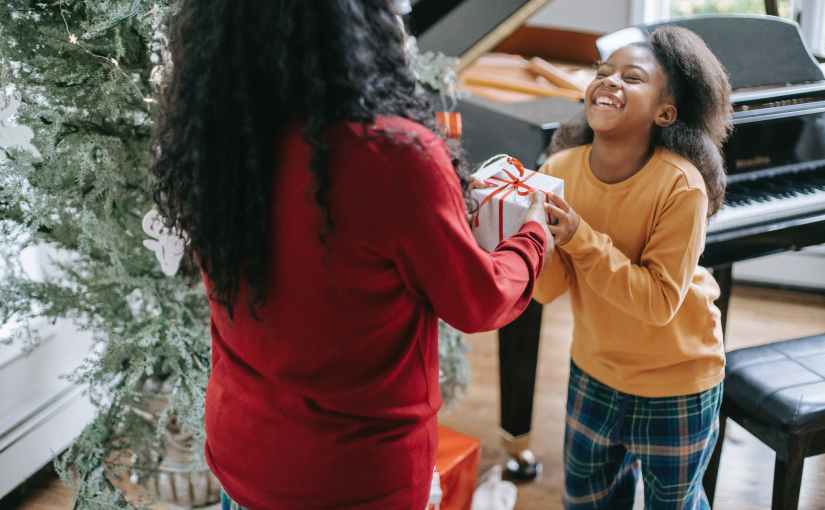
And kids learn the genuine joy of giving. I remember a gift I got from Emily. She was about five years old, and she was so excited for me to open the gift she’d gotten me. She bounced in her seat with anticipation. When I opened it, I saw a large necklace full of zinc zirconium (bright, “diamonds”). I’d asked for a “chunky” necklace, and she’d delivered. Part of her enthusiasm was, she explained, because the necklace was in the jewelry case at Target. To her, getting something from the jewelry case was truly special. I think she was more excited to watch me open my gift than she was to open her own. I couldn’t help but be touched. That was years ago, and I still remember it. True holiday spirit.

We’ve found so much joy and value out of this approach, I hope others will do the same. Please don’t be deterred by the possible cost. You can give homemade gifts. If you’re not naturally creative, it might feel odd at first, but if everyone is doing it, the appreciation for the thought and effort will come.